Showing posts with label mank. Show all posts

Monday, March 5, 2012

Van Duzen River--The Bloody Run Day Two


Check it out, Explore Six Rivers Source to Sea
If you haven't read it here is the Day one description
 Here is Paul's Helmet Cam Footage of the Bloody Run

Photo: Wes Shrecongost

We slowly woke up on the second day to a cold heavy frost.  After staying in our sleeping bags to retain warmth the sunlight peeked up over the hillside and its strong rays coaxed us from our cozy confines to  get ourselves fed.  Knowing it would be another full day on the water we optimistically hoped that at some point the river character would change and open up into more runnable rapids.

Photo: Wes Shrecongost
The river level had dropped only slightly overnight and after we packed our boats and pumped drinking water we were ready to go by nine o clock. 


Downstream from camp we were treated to an easy section of water with beautiful Van Duzen scenery before more congested boulder gardens reappeared and it was back to the portaging routine.
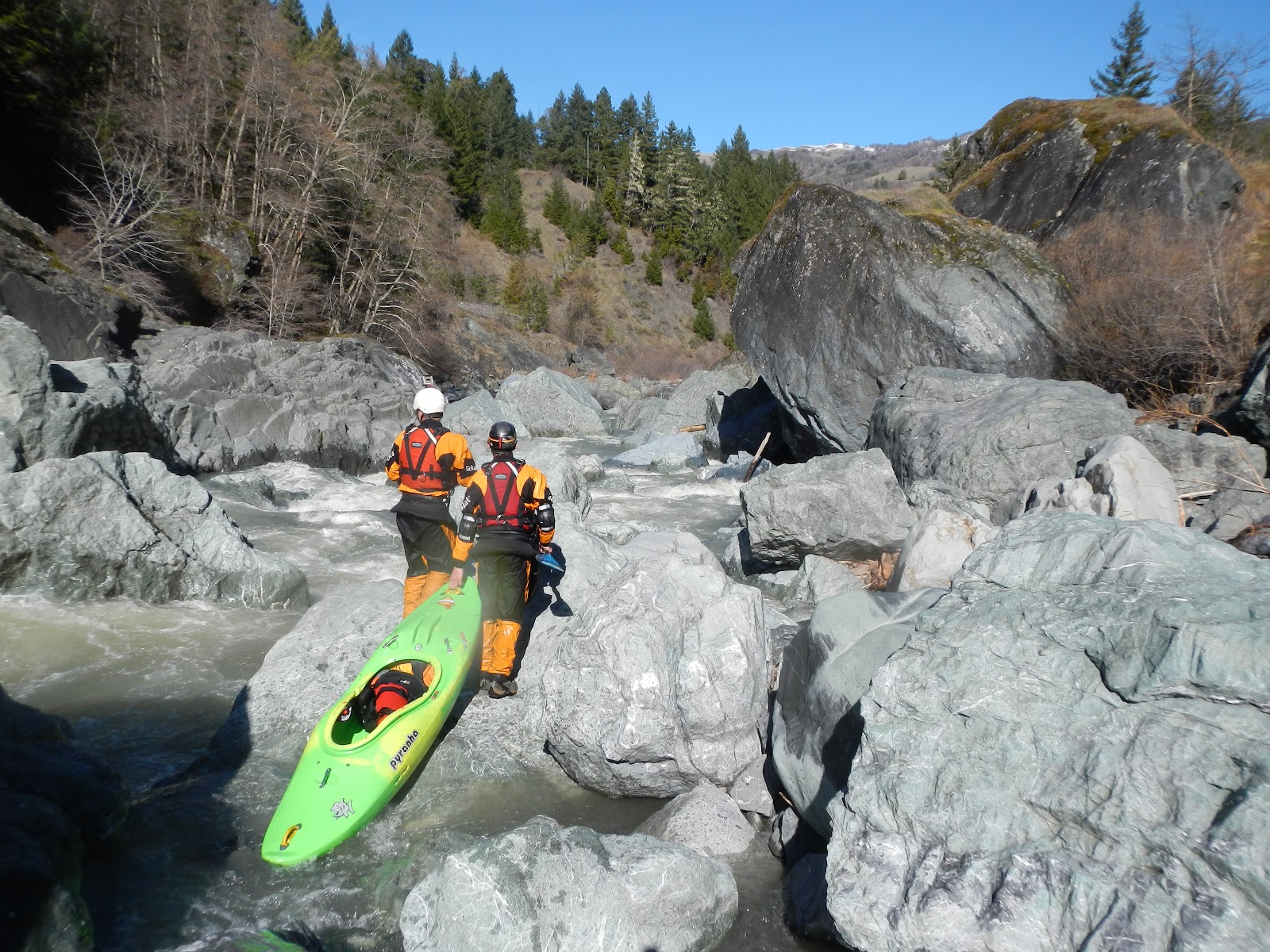
Photo: Wes Shrecongost

The river seemed to be changing for the better, as we found good lines through more rapids than the previous day.  Our runnable rapid to portage ratio began to balance out closer to 50:50 and we enjoyed some of the best rapids of the run.


This still meant dealing with many large boulder gardens that made for exhaustive portaging, not to mention we were all shagged out from the previous day’s efforts.  Get back up to the hillside...yeehaaaawww!


Now go through that poison oak bush...you know you like it!

Photo: Paul Gamache

Finally we reached an extended calm period of water and began to get our hopes up that we had passed the meat of the run. 

Photo: Wes Shrecongost
We now refer to this as the Glimmer of Hope, because shortly downstream the river slid into yet another boulder gauntlet.  Checking our GPS we realized how many more miles lay ahead and started to push harder in hopes of keeping our trip to a 2-day.  

Photo: Paul Gamache
The canyon began to open up with beautiful scenery characterized by enormous chunks of rock.  At this point we also were starting to Bonk. 

Photo: Paul Gamache
Hmmmm...big seal launch into murky brown water of unknown depth or climb around on some giant boulders with a heavy loaded kayak for the hundredth time?

Photo: Paul Gamache
Fortunately for me and Wes, the murky brown water was deep and unobstructed.


Just downstream another fun rapid pinched before pushing into an undercut that couldn't be seen from above.  Wes probes it out.


After a couple more miles of better rapids, the gradient was gradually dropping and we started covering miles without making a portage.  There were some interesting rapids thrown into the mix too.


Wes attempting to spot his line through another boulder jumble

Photo: Paul Gamache
Finally, we passed the namesake drainage, Bloody Run.  This creek comes in from river left and marked the end of the high gradient sections.  It also appears to have remarkably high water quality considering the brown nature of many other smaller side-streams.

Photo: Paul Gamache
One more tricky portage remained downstream before the Van Duzen flattens out for the remaining miles to Bridgeville.

Photo: Paul Gamache


  We passed one massive landslide in here that looked like the entire hillside was basically flowing into the river and it turned out being the final portage of our trip!  We relaxed and paddled the flatwater through beautiful scenery the rest of the way.

Photo: Paul Gamache
Eventually we arrived at the confluence with Little Larabee Creek and Highway 36.  After some celebratory high-fives, Wes made his way up to the road where the very first vehicle driving by picked him up. 

The Bloody Run is an adventure that I hope to repeat someday.  I feel like our mission opened up a run that may become a “cult classic” along with the Grand Canyon of the Mad River, just over the hills.  Several times we found ourselves portaging on the wrong side or around sections we could have committed to had we known there were lines.  With slightly higher water levels many possible routes would open up although many of our portaging options would be limited too since they were at river-level.  I know the write-up description makes it sound like all we did was portage, however looking back at Paul’s helmet cam footage we were also able to run many quality rapids as well.  Best of all, by starting out our Six Rivers Source to Sea Mission with a banging first descent, we gathered the momentum and confidence we needed to keep the ball rolling!


Major points from the trip:
If we had more time we could’ve run more rapids

The Little Van Duzen is a better put-in than Highway 36 to avoid a massive portage near Dinsmore and include another great section of river.

Information about the previous trip got twisted by each successive storyteller, to the point where it was virtually useless.

Exhausting nature of portaging/scouting- The never-ending onslaught of mind-bending boulder gardens takes a toll on your mental awareness and ability to maintain focus.  

Miles were extremely hard for us to cover.  Every time it seemed that we were going into a more runnable stretch of river we found a difficult portage or scout instead.  At one point we were making 1/2 mile an hour.

Difficult decision-making: to portage over this boulder or around that one, to portage up to a grassy hillside or stay at river level.  The river disappears into a boulder garden where 4 of the 5 slots are sieved-out and it becomes difficult communicating lines back to the crew through this complex of rapids.

Importance of bringing overnight gear: although it made our portages much more difficult and extra effort, the gear became worth its weight in gold once it became clear that we wouldn’t be making it out in a single-day. 


Importance of having a map, or GPS to locate yourself and realize how much farther you have to go.

Importance of picking a good campsite, one with flat spots and wood to burn, at the right time of day before it gets too dark to set-up camp.

Sometimes you just have to put your head down and start charging through the poison oak, otherwise it would be impossible to accomplish this river.  However I am happy to report that three weeks later I have no signs of the P.O.!  


The importance of a good crew cannot be stressed enough, we all proceeded safely and patiently which contributed to our safe return.


Going on adventures, even those which require lots of portaging, are still always worthwhile for the sense of accomplishment and change of perception they can provide.

Sunday, February 19, 2012

Van Duzen River--The Bloody Run Day One

Van Duzen River—The Bloody Run


First descents have a range of shapes and forms.  There are the hidden gems, the ones that never flow, streams on private property, some first descents are simply too remote and require creativity or miles of hiking to access.  Some first descents with access are simply avoided because of the known difficulty they present.  Then there are the first descents that have been attempted, unsuccessfully.  These streams fall into a different mindset among the paddling community, tried but not completed.  The river has already been tainted by the scraped off plastic of paddlers before you while lingering stories of pins, swims and hike-outs in the dark reinforce the brooding nature of the run.  The latter two describe the Bloody Run.

Photo: Wes Shrecongost
 The Van Duzen River is one of the Six Rivers flowing across the Six Rivers National Forest of Northern California.  The Duzen’s legacy began early when explorers through the area found the going extremely difficult.  The river was named after a member of the Josiah Gregg party of 1850.  The namesake drainage, Bloody Run, flows into the Duzen near mile 15.  As with most other “Bloody” placenames, Bloody Run is tarnished with the legacy of Native American slaughter in the area.  With easy access to put-in and take-out, however, it is a wonder that the Bloody Run hasn’t been paddled.  It has, however, been attempted.  A previous mission involving the formative Ben Stookesberry and Adam “Chowdy” resulted in the aforementioned pins and hike out in the dark.

Kayakers in the area have known the Van Duzen to have unfavorably dynamic geology that produces many landslides.  A short drive upstream from the classic class III Grizzly Creek section reveals Goat Rock Falls, a notoriously rugged rapid decorated with house rocks, strange hydraulics, wood and sieves galore.  This rapid is a sight to behold at higher flows up to 20,000 cfs, when it becomes a hideous and awe-inspiring cataract of watery explosions.    My imagination painted a picture of the Bloody Run as 15 miles of Goat Rock, and I never felt a need to put myself through enduring the many hardships of portaging and scouting that this might entail.  Enter Paul Gamache and the Six Rivers Source to Sea Mission.

Photo: Wes Shrecongost
With a need to paddle all Six Rivers now in play, we set our sights at the Bloody Run as the first mission to be done.  Partially it was a lack of water in the area, since 2012 has been among the driest California seasons in memory.  Fortunately the optimal level we wanted for the bloody run was relatively low, 1,000 cfs, at which the Duzen flows commonly.  The rain finally came and brought the rivers up allowing Paul and I to decide on a mission to keep us away from our Valentines; Grand Canyon of the Mad, or the Bloody Run.  In hopes we’d be able to accomplish the mission in one day we elected for the Bloody Run, knowing the Mad would be a mandatory two-day.  Our need for a third member of the party led to a call and soon Arcata up and comer Wes Shrecongost was onboard.  With the crew arranged, we planned for a long one day, but decided to pack for an overnighter, just in case.  After a pre-dawn start we headed up Highway 36 to a beautiful Valentines Day sunrise.  Climbing up the twisty road the scenery shifted to snowy hillsides as the previous storm had obviously been a cold one.  

Photo: Wes Shrecongost
Finally arriving to our put-in at Dinsmore, 2,600 feet elevation, we gathered our gear quickly and put-on the river with a reasonable 9:00 departure.  “I think I’m going to leave my stove”, said Wes, in an effort to pack light.  “I’ll carry it” I quickly replied.  With a nervous anticipation we carried our boats down to the river and put on.

Photo: Wes Shrecongost
Less than a half-mile into the run, we arrived at our first portage “Here we go”.  This one wasn’t too bad, but shortly downstream we arrived at another massive boulder pile, portage #2.  This one was longer and we began to get a feel for the difficulty of portaging in a landscape totally absent of flat, even ground and stable footing.  Portaging through a backwater, Paul realized his relief zipper was undone when cold water spilled into his drysuit.  He cursed himself for the mistake but carried on unabashedly.


I had a little beta from my friend Chowdy soloed these first couple of miles in 2004 and told me about a major falls.  Before long we reached it.  The river dropped through a hideous gorge with major rock fall before continuing downstream.    

Photo: Paul Gamache
We decided the best portage route was the left side and began our longest carry of the entire trip.  After climbing to a mossy precipice, we spotted some Madrone trees along the edge of the canyon that appeared to be on the best route.  I quickly realized that avoiding Poison Oak to get there wouldn’t be an option.  We humbly put our heads down and started charging through the vile plants.  After returning to river level, we paddled a sweet drop before arriving at another portage.  This would be the theme of our trip: run a rapid, then portage the next.

Photo: Paul Gamache

Downstream a bridge crossed the river as it let up momentarily allowing us to soak in the scenery, the surrounding hills were laced with snow and sun was peeking out.  

Photo: Wes Shrecongost
We quickly entered another gorge where a sweet entrance boof brought us to a mandatory portage over a rock within a gorge-clogged-by-the-rock. 

Photo: Paul Gamache
Tricky Teamwork Portaging
Photo: Wes Shrecongost
Paddling away from here we arrived at the confluence with the South Fork, or Little Van Duzen, depending on which map you check.  This adds some much-needed flow and immediately the river takes on a larger and more open character, it is still stuffed with enormous boulders, however.  After a hopeful half-mile of nice paddling we arrived at another gradient section.  


Photo: Paul Gamache
This one was a maze, the river dropped away into a boggling boulder garden so tight you could hardly see the water flowing between the rocks.  We elected to portage the high line; around the cliff on the right and up to a grassy hillside that looked like easier going than the river level rocky route.  This unfortunately was not a good decision, as we found ourselves looking far down the hillside at a couple of sweet rapids that we were now portaging.  


Photo: Wes Shrecongost
And now we had to find a way back down to the river.  Being that it was after noon, we took a quick break in the sun and chewed on some energy bars.  Paul checked the GPS and informed us of our status, “It appears we’ve gone 5 miles”.  Knowing we were hoping to cover at least 15 miles, it began to set in that we were probably on a 2-day descent at this point and I elected to save my burrito for later.

Photo: Wes Shrecongost
After lowering our boats down a landslide we reached the river and immediately had to portage again.  I found a sneaky route between a crack in two boulders and put-on, heading down to scout the next drop.  Paul and Wes however were unable to find a way to the river here and nowhere to be seen.  After scouting the rapid and looking around for the boys I started to feel a little lonely and wound up running a couple of more drops downstream to where I assumed they were.  Eddying out above another portage rapid I was relieved to see my crew finishing their long portage down the right.  


Photo: Wes Shrecongost

We were able to charge downstream through some fun rapids and I got out to take a look where the river gorged up again.  Climbing up to the edge of the gorge I looked straight down into another sieved-out mess, this one with even bigger boulders!  

Photo: Paul Gamache
Signaling it was a portage to the boys, we began working our way downstream through massive boulders on the right.  

Photo: Wes Shrecongost
Eventually we reached an overhanging area where we seal-launched into the outflow of a sieve exiting via. a sweet boof through a sticky hole.  


 Here is Wes in the Armpit Drop


Paul charges through the armpit


 The river then flowed placidly to the next pile of rocks requiring a portage downstream.


Photo: Paul Gamache
We reached a terrific section of river and covered an easy mile before giant boulders reappeared forcing us out of our boats again.  It felt like the river was teasing us, trying to make us think we’d make it out in a day when we really had no chance.


Photo: Paul Gamache
Yes, the river flows beneath that boulder too.

Photo: Paul Gamache
It eventually became accident hour as the grueling portages and mental challenges were adding up causing the crew to begin making mistakes.  Sloppy lines, mini-pins and slipping while portaging combined with the falling darkness urging us to start looking for a camp spot.  After inspecting one substandard site, we paddled one final rapid before reaching a road on the right bank.


Photo: Paul Gamache
There was an enormous flat with some oak trees and we quickly began gathering driftwood to build a fire for warmth, our number one priority.  A chilling fog had rolled up the canyon and it began raining lightly, “the weather was supposed to be sunny”, but the Humboldt Fog had done it again.


Photo: Paul Gamache
 High fives all around as we were safely together, Paul sent out the “All Good” message on the SPOT device and we checked our location on the GPS…9 miles of progress, not bad, we’d made it well over halfway and looked forward to a mellower second day on the water with less gradient.  Our fire began to roll as we started drying off our fleece layers, cooking up some food and rehashing our days adventure.  The stars came out and a biting wind caused drops of water to fall from the trees, but the fire raged on and we turned in for the night.

Sunday, June 6, 2010

An Ode to Bridge Creek!

Well, I might as well share the pics I've got from my most photographed, and favorite creek run!
Especially considering that this summer it will probably be running into July, its latest season in years!

Disclaimer: Its initial classic reputation became tarnished as numerous epic mis-adventuresome stories began to emerge.  However, if you consider the 440 fpm gradient average (300, 475, 525), epic hike-in, beautiful wilderness, amazing bedrock, supreme solitude, and 10 miles of classic Wooley; the initial classic reputation must linger on!  Here's the Solution: take this run seriously, get an early start, bring break-down paddles and food make sure you can navigate off-trail, and don't dilly-dally unless you brought gear for a 2-day (Highly Recommended and pleasurable!).  The hike-in is the most daunting task!

After 13 trips down Bridge, a couple planned overnighters, and a hike out down Wooley in the dark, this is my favorite creek.  It is one of the best waterfall training runs around, with no single drop greater than 20'.  This is where I learned to plug-boof waterfalls.  If your cup of tea is 20' plus, heed the words of my friend Dave Norell, who stated "none of the falls were big enough!"  Time to move to Hood River.

Damon Goodman and Seth Naman in the midst of the "Mank Mile"

Plan on portaging two drops in the Mank Mile, the slippery log portage comes 1/4 mile down from put-in after the creek flows through a meadow and turns left.  It is a mank cascade, runnable without wood.  Leif's Purple Toe is a 30' boxed in drop that dished out Mulleticious consequences in 2007.  This comes after a calm pool and is portaged right though we've been portaging over a log spanning the drop.  Purple Toe Gorge is changing rapidly, any year I expect it will be different.  Once past this drop, my stoke level starts to climb.

Damon Goodman in "First Taste"

Damon Goodman exits "First Taste"

Orion Meredith plops the "Bobsled Run"; a sweet sliding entrance kicks off the First Waterfall

Immediately below Bobsled Run lies Medicine Falls.  This drop is best boofed with right to left momentum.  I've pitoned this at low flows, as an underwater shelf juts out from the right.  At higher flows this hydraulic is powerful and safety is extremely difficult to set!

Mike Lee drops Medicine Falls

This marks the beginning of a high quality stretch of bedrock drops and low angle slides.  After a tight right turn and increase of gradient you approach the Rooster and Fucker Rock.

Plugging The Rooster: Photo Curt Welsh

Mike Lee portaging "Fucker Rock" immediately downstream from the Rooster

Story Time: Fucker Rock
This drop has changed remarkably on a near-annual basis.  We used to run a boof onto a rock that bounced you very near the left wall.  Now we portage this mandatory-hit manker.  One fine day (2004) I was paddling with my friend Gabe Forsythe.  His line through F-Rock was hideous--he flipped as he was coming off it.  When he tried to brace, his paddle stuck into the drop, resulting in him falling straight through and breaking it.  Neither of us had a spare paddle, I had brought my NRS handpaddles instead.  We were approx. halfway down Bridge, with most of the big drops ahead.  
Gabe stood up to the plate--hand paddling the rest of Bridge creek, mostly on verbal directions.  He portaged Toilet-Bowl and the Penalty Box, but ran everything else; often styling moves with the dynamic hand-plant.  When we reached Wooley I asked if he would like to trade-off the paddle.  "Nope", Gabe said and continued to Hand Paddle the 10 miles of Wooley also.  Remarkable Bridge Creek Achievement! 

Miguel hits the "Kicker Slide"

Miguel speeds through "Amnesia"

Curt Welsh takes the "Magic Carpet Ride"

Magic Carpet marks the one-mile mark to Wooley Creek.  It is the most picturesqe drop on the run and forms severe hydraulics as the flows increase.  You have officially descended into Poison Oak territory.  Continuous manky boulder gardens continue downstream from here and it is a very good place to be on your toes.  The next major horizon line is the Teacups, scout left before blundering into them.

Flowdaddy boofs the first teacup with right angle.

Damon Goodman backlit in "The Teacups"

The Teacups is a legitimate 3 part rapid, containing a very tricky and congested entrance boulder garden.  This drop is so legitimate in fact, that at a flow of 5.5' a crew of 6 paddlers had 4 simultaneous swimmers here, one in each drop at the same time.  

Silent Ed lines up "The Toiletbowl"

The Toilet Bowl is definitely the stoutest drop on the run.  The horizon line is hidden behind a large boulder, and comes during your typical busy-water boulder garden.  Be on your toes to scout right and/or portage this one.  Maintaining slight left momentum and launching a boof can help you to avoid this amazingly unique and sticky hydraulic.  On a previous run I was surfed in this hole, scrambling to stay out of the way of my buddy Andrew Bell, who came off the drop and gave me a funny look as he cleaned the line.  I was swirling in the bowl while he eddied out and came to feed me a rope.  I then flipped and decided I would rather try to paddle out myself.  After surfing the hole across the boil I made it out.  Moral: if you're paddling in a 2-pack, consider setting safety for your friend so you don't both wind up in the bowl.

Another time I was in the toilet bowl, my friend Seth Ricker fed me a rope properly...he pulled it while hunched down to maintain a low-center-of-gravity-pull.  This kept me from flipping, though he needed a pull from our buddy Matt Fayhee to prevent him from sliding across smoothly polished slippery bedrock.  This drop can be portaged rather easily on the right, but be careful as I've seen several paddlers walk right through the enormous poison oak bush here.

Your next scout is the Pearl Necklace, which comes shortly downstream.  This is an amazing crack to slide drop, I used to walk it, but now its my favorite.  People who walk it can seal-launch into the slide, but I've seen at least 4 different folks slide into this drop while portaging the mossy slab.

Seth Naman squirts through the "Pearl Necklace"


Flowdaddy


Pearl Necklace is a slippery portage. Clint learns the hard way.
Great shot of typical Bridge water

Downstream of the Pearl Necklace, rapids continue to the Penalty Box, recognizable by a cliffed out right wall and a left-hand bend.  This is the worst hydraulic on the run, scout, set safety and/or portage on the left.  The portage requires teamwork and delicate climbing to avoid falling into the drop.  Poison oak is abundant here.  

Penalty Box--Set safety and Boof the Hell out of it!
Photo: Mike Lee

On our first trip down bridge in 2000 (before we found the put-in trail), Guillo Torres was giving our crew of 8 verbals as we paddled in dusk.  We were racing to reach Wooley before dark.  In the eddy above I was told to go left and watched Ligare paddle into the darkness.  Upon entering the slide though, I could see the creek fell into the left wall and quickly stuck my boof to the right.  One after one, our friends came off the drop, with large smacks to the wall echoing in the canyon.  We couldn't see 'em but we could hear 'em.  It is amazingly fortunate that we didn't have any swims that day.  The Penalty Box actually becomes more sticky at lower flows due to the bowled out hydraulic and bedrock-pinch exit. 

Two more rapids remain, a mini-gorge on a corner and Bridge Creek Falls--The Grand Finale.  

Mike Lee drops into Bridge Creek Falls
  

Matt "Flowdaddy" Flofo drops Bridge Creek Falls

I can't think of a prettier creek anywhere.  You've now descended from fir and cedar to oak and pine.

Camping at The Wooley Cabin

My new favorite logistics are to plan a 2-day and camp upon arrival at Wooley Creek.  This is especially a good method if you haven't heard wood reports yet, or haven't done the run before.  The cabin is a 1/4 mile hike up (left bank) Wooley from Bridge Creek Falls.  This will allow you plenty of time to scout, set safety and rest before you test your mettle against Wooley.  

Flows: between 4 and 4.75' on Salmon @ Somes Bar for first timers.  This is a class V run.  Above 5.5' it can produce other-worldly hydraulics to Boof or Die! (Even though the Knapps paddled it over 7' once)